
A Practical Guide to Packaging for Street Food Vendors, Food Trucks & Festivals
- Biofuture

- May 19
- 5 min read
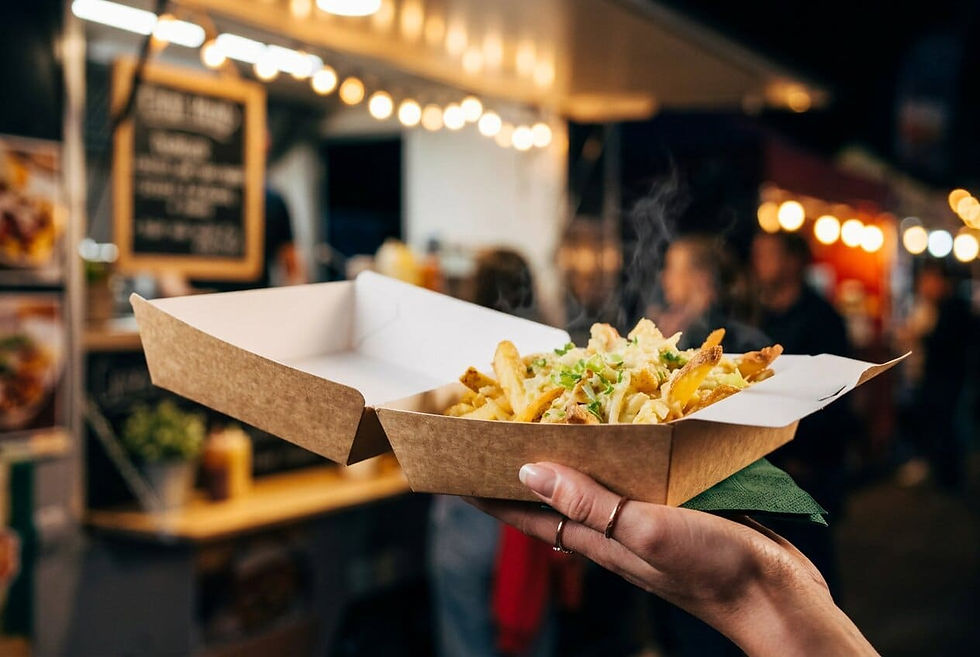
Great food deserves packaging that performs just as well as the meal itself. For street food vendors, food trucks, festival traders and mobile caterers, packaging is not just a container. It affects food quality, service speed, customer experience and brand perception.
At the same time, expectations around sustainability continue to grow. Customers increasingly look for fibre-based, compostable or lower-plastic packaging options, while many event organisers now require vendors to demonstrate more responsible packaging choices.
But choosing the right packaging today is no longer as simple as selecting something labelled “eco-friendly.” Packaging must perform in real-world service conditions, and disposal routes vary depending on the food type, event setup and local waste infrastructure.
This guide breaks down the practical realities of street food packaging and helps you choose the right solution for your menu and service environment.
What Street Food and Food Truck Packaging Needs to Handle
Mobile catering packaging faces very different demands compared to café or retail environments.
A takeaway box might perform perfectly indoors, but struggle during outdoor service when exposed to movement, heat build-up, moisture and transport time.
Street food and food truck packaging typically needs to handle:
heat and steam from freshly cooked food
grease-heavy dishes
portability during movement
stacking in tight storage spaces
fast-paced service environments
outdoor weather conditions
limited prep and holding space
In practice, vendors often find that leak resistance, stackability and structural strength become more important than initially expected, particularly during peak service at festivals and events.
Kraft, PLA and Compostable Packaging Explained
Understanding packaging materials is key to making the right choice.

Kraft Packaging
Kraft packaging is fibre-based paperboard commonly used for takeaway boxes, trays, burger boxes and cups. It is popular due to its natural appearance, strength and versatility.
PLA Lining
PLA (polylactic acid) is a plant-based biopolymer derived from renewable sources such as corn starch or sugarcane. It is commonly used as a lining inside kraft packaging to improve grease and moisture resistance.
This combination of kraft and PLA is widely used in foodservice packaging because it balances functionality with certified compostable material systems. If you want to know how it compares to traditional plastics, you can read our deep dive into what compostable plastic is made from.
Other Common Materials
bagasse (sugarcane fibre)
moulded fibre containers
wooden cutlery and skewers
compostable bin liners for waste separation
Each material performs differently depending on food type and service conditions.
Why PLA-Lined Kraft Packaging Works Well for Mobile Catering
PLA-lined kraft packaging is widely used in street food and mobile catering because it performs reliably under demanding service conditions.
Key benefits include:
improved grease resistance
reduced leakage risk
better heat and moisture handling
strong structural integrity
suitability for hot and cold takeaway foods
stackable, space-efficient design
It is particularly effective for:
burgers and fried foods
loaded fries and street food trays
curries, noodles and saucy dishes
takeaway coffee and hot drinks
From a practical perspective, packaging that performs consistently during busy service is often prioritised over purely material-led sustainability claims.
Compostable Packaging and Disposal Reality
Many PLA-lined and fibre-based packaging products are certified to industrial compostability standards such as EN13432. This means they are designed to break down under controlled conditions found in commercial composting facilities.
However, disposal routes vary significantly across the UK.
Some waste systems accept compostable packaging, while others do not, particularly where food waste processing infrastructure is limited or inconsistent.
It is important to understand that:
industrial compostable does not mean home compostable
acceptance varies by local authority and waste contractor
disposal instructions should always reflect local conditions
Despite this, compostable packaging can still be a practical choice in environments such as festivals, event catering and food courts where waste is managed at scale.
Choosing the Right Packaging for Different Foods
Different food types require different packaging performance characteristics.
Food Type | Key Challenge | Recommended Packaging |
Burgers & Fried Foods | Grease resistance and steam build-up | |
Loaded Fries & Street Food Trays | Heat retention and portability | Sturdy kraft takeaway trays |
Curries, Noodles & Saucy Foods | Leak resistance and moisture control | PLA-lined kraft containers and bowls |
Coffee & Hot Drinks | Insulation and lid security | |
Festivals & Events | Speed of service and stackability |
This type of structured approach helps vendors quickly match packaging to menu requirements rather than selecting based on appearance alone.
Sustainability Without Greenwashing
Sustainability is an important consideration in modern foodservice packaging, but environmental claims are increasingly subject to scrutiny.
Terms such as “eco-friendly,” “biodegradable” and “sustainable” are now being evaluated more closely across the industry, particularly where definitions are unclear or unsupported.
A more reliable approach focuses on:
fibre-based materials
certified compostability standards
responsible sourcing
realistic disposal guidance
packaging suitability for specific use cases
Clear, accurate communication is becoming increasingly important as regulations and customer expectations continue to evolve.
What We’ve Learned From Supplying Foodservice Packaging
One consistent observation from working with foodservice operators is that practical performance usually outweighs everything else.
Vendors typically prioritise:
leak prevention
heat resistance
ease of handling
stackability during transport
speed of service
Once those needs are met, sustainability and presentation become key differentiators.
We’ve also seen that packaging plays an increasingly visible role in customer experience, particularly in street food environments where food is often photographed and shared online.
Flexibility is also important, especially for smaller operators. Many food trucks and street food businesses do not have the storage capacity for large bulk orders, particularly when testing new menu items or trading seasonally. As a result, case-sized ordering has become a practical advantage for many independent traders.
Frequently Asked Questions
Is PLA-lined kraft packaging recyclable?
Recyclability depends on local infrastructure, packaging design and contamination levels. Many operators use PLA-lined kraft packaging because it provides a fibre-based structure with grease and moisture resistance.
Is PLA-lined packaging compostable?
Many PLA-lined packaging products are certified to industrial compostability standards such as EN13432, meaning they are designed for commercial composting environments under controlled conditions.
What is the best packaging for food trucks?
The best packaging depends on the menu, but most operators prioritise leak resistance, heat performance, portability and stackability when choosing takeaway packaging.
What packaging works best for festivals?
Festival packaging typically needs to support high-volume service, durability and easy handling, while also aligning with event waste management systems.
Final Thoughts
Selecting packaging for street food, food trucks and festivals is ultimately about balancing multiple priorities:
food performance
customer experience
operational efficiency
sustainability considerations
realistic disposal pathways
PLA-lined kraft packaging remains a widely used solution in mobile catering because it offers reliable performance in demanding service environments while supporting fibre-based packaging systems.
As expectations around packaging continue to evolve, operators who focus on practical functionality, clear communication and responsible material choices will be best positioned for long-term success.
Need Expert Advice for Your Mobile Catering Business?
Choosing the right packaging balance for a busy event or a demanding menu doesn't have to be a guessing game. Whether you are a standalone food truck looking for reliable case-sized ordering, or a high-volume event caterer sourcing at scale, we are here to help.
Get in touch to discuss your menu's operational needs, request samples, or set up a tailored supply arrangement for your upcoming season.


